
Violence is visible. The system that sustains it is not.
Cartel Systems examines the causal architecture behind coercion: how resources, institutions, markets and local dependencies can keep a system viable even when its actors change.
Tijuana–San Diego, 14 April 2017 · NASA / ISS Expedition 51. Geographic context—not a depiction of criminal activity. Image source & public-domain record ↗

What survives when an actor is removed?
Leadership removal can be tactically successful and structurally incomplete. Finance, logistics, protection, recruitment, corruption and replacement pathways may remain viable.
The unit of analysis is not a cartel as a static organization. It is the architecture that keeps converting resources into coercion, compliance and renewed capacity.
This study does not rank cartels or recommend operations. It shows how a governed evidence universe can support structural diagnosis, future-space analysis and intervention design.
Six environments. A shared causal boundary.
Formal and informal systems remain distinct, but their effects cross the boundary of any single institution, market or organization.
Criminal organization
Factions, cells, leadership, recruitment, coercion, adaptation and succession.
State & institutional
Police, prosecution, courts, municipal capacity, corruption risk and coordination.
Economic
Illicit and licit markets, extortion, logistics, labor, finance and substitution.
Social & cultural
Community protection, fear, trust, dependency, identity and perceived inevitability.
Transnational
Demand, arms, finance, commodities, precursor flows and jurisdictional displacement.
Information
Reporting, observability, leaks, narratives, intimidation and institutional memory.
Criminal governance is not only a Red system.
Force is visible. The capacity to regenerate it may depend on resource flows, accepted rules, fear, protection and institutional access.
Power is produced through conversion, not possessed as one asset. Resources sustain force; coercion can induce compliance; protected markets can renew resources. Each connection is a hypothesis to examine against local evidence.
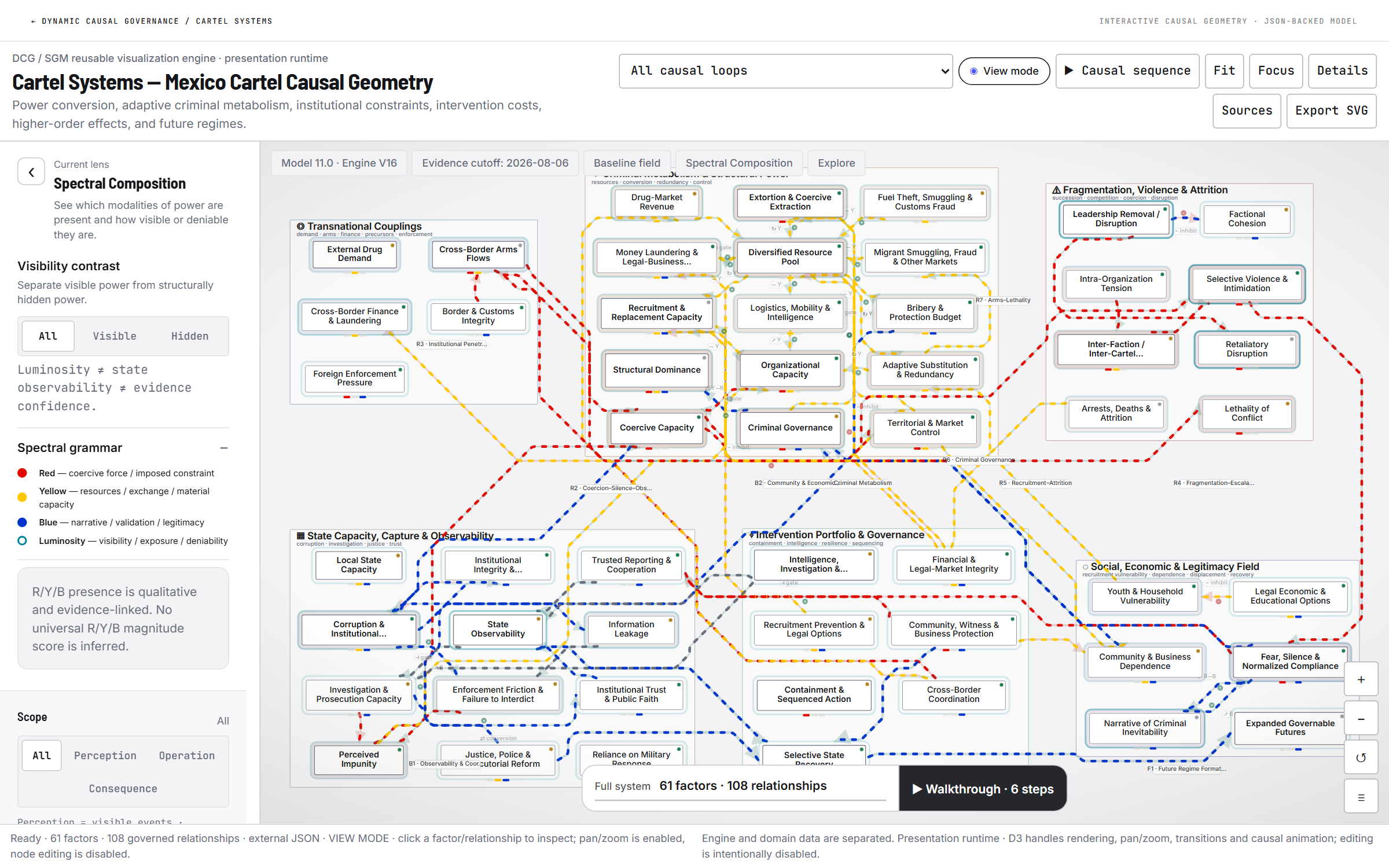
Luminosity modifies visibility and amplification. Whether a vector is visible, proxied or deniable is not the same as confidence in the evidence.
Imposed cost, force and constraint.
Logistics, recruitment, resources and substitution.
Accepted rules, identity and perceived legitimacy.
The public SGM grammar distinguishes modalities and their conversion. It does not assign a universal power score.
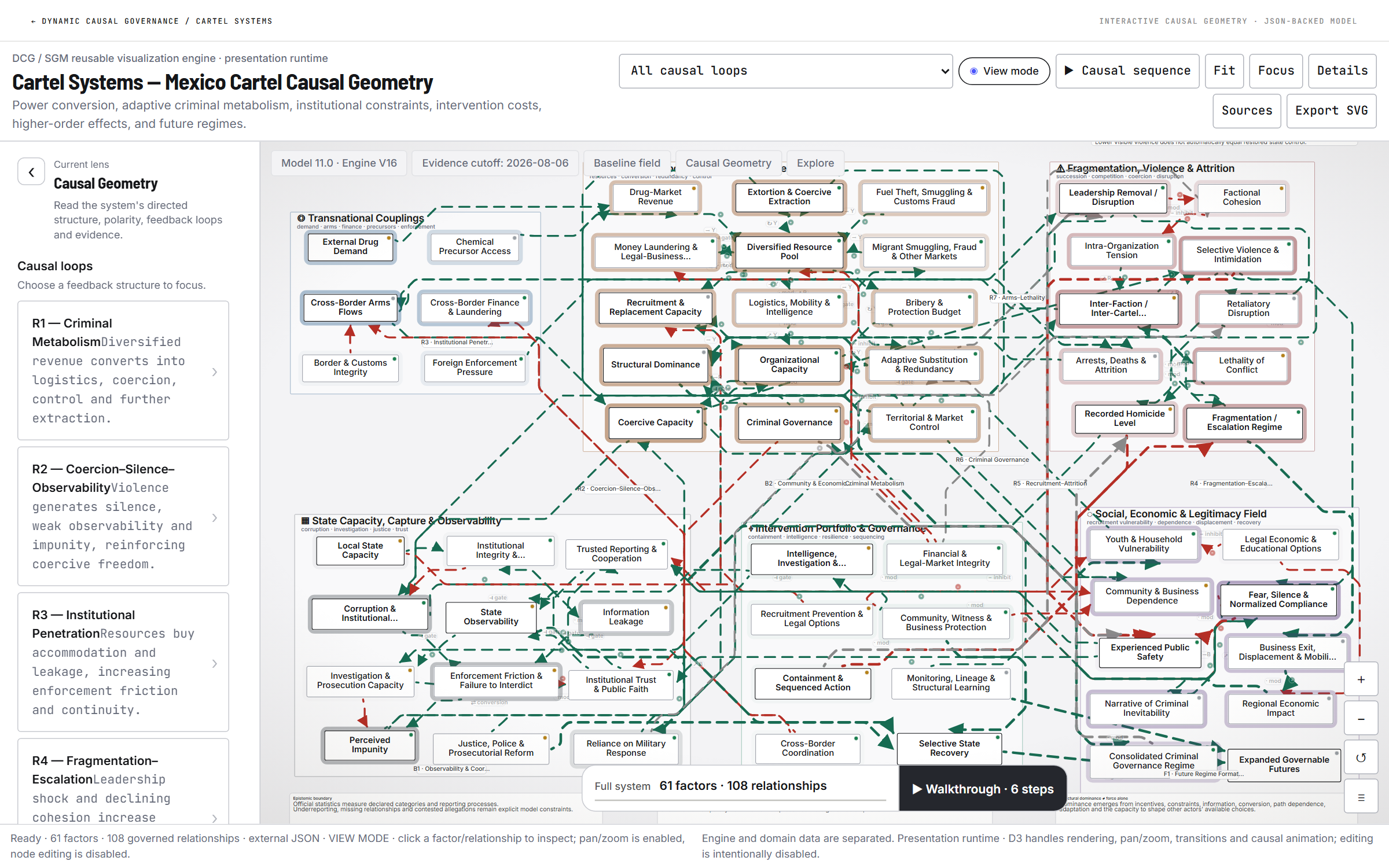
Read the Spectral Governance Model →Seven loops reproduce the system. Two can change its direction.
These are causal hypotheses to test locally—not a universal script. The distinction is between feedback that reproduces a regime and feedback capable of weakening it.
Revenue sustains capacity
Resource channels feed logistics, corruption, recruitment and coercion; closure can trigger substitution.
Silence reduces observability
Fear weakens reporting and investigation, reinforcing perceived impunity.
Capture protects continuity
Leaks and compromised processes reduce sanction probability.
Splits can increase violence
Reduced organizational coherence may intensify territorial competition.
Attrition creates replacement demand
Losses increase recruitment pressure when vulnerability and opportunity remain.
Dependency normalizes shadow rules
Coercive dispute resolution and conditional protection can displace formal legitimacy.
Force availability raises conflict cost
Cross-border resource fields amplify local contest without determining it alone.
Balancing pathways
Protected information improves response
Credible reporting and coordinated cases can raise sanction probability.
Community protection weakens dependency
Economic and institutional alternatives can reduce the reproduction of coercive governance.
Actor removal and system removal are different questions.
Sinaloa, CJNG, Michoacán and transnational dependencies reveal distinct mechanisms. They are not interchangeable cases or entries in a ranking.
Fragmentation as regime shift
The 2026 Mexico Peace Index reports Sinaloa homicides rising from 1,022 in 2024 to 1,732 in 2025 during internal conflict. The structural question is how contested succession changed local violence and observability.
Leadership versus network
Leader removal and system removal are analytically distinct. Distributed revenue, logistics, enforcement and succession can preserve continuity.
Parallel economic governance
Extortion can function as compulsory taxation and rule-setting across licit production, not only as episodic predation.
Arms, finance and markets
Domestic coercion is coupled to external demand, resource access, jurisdictions and substitution pathways.
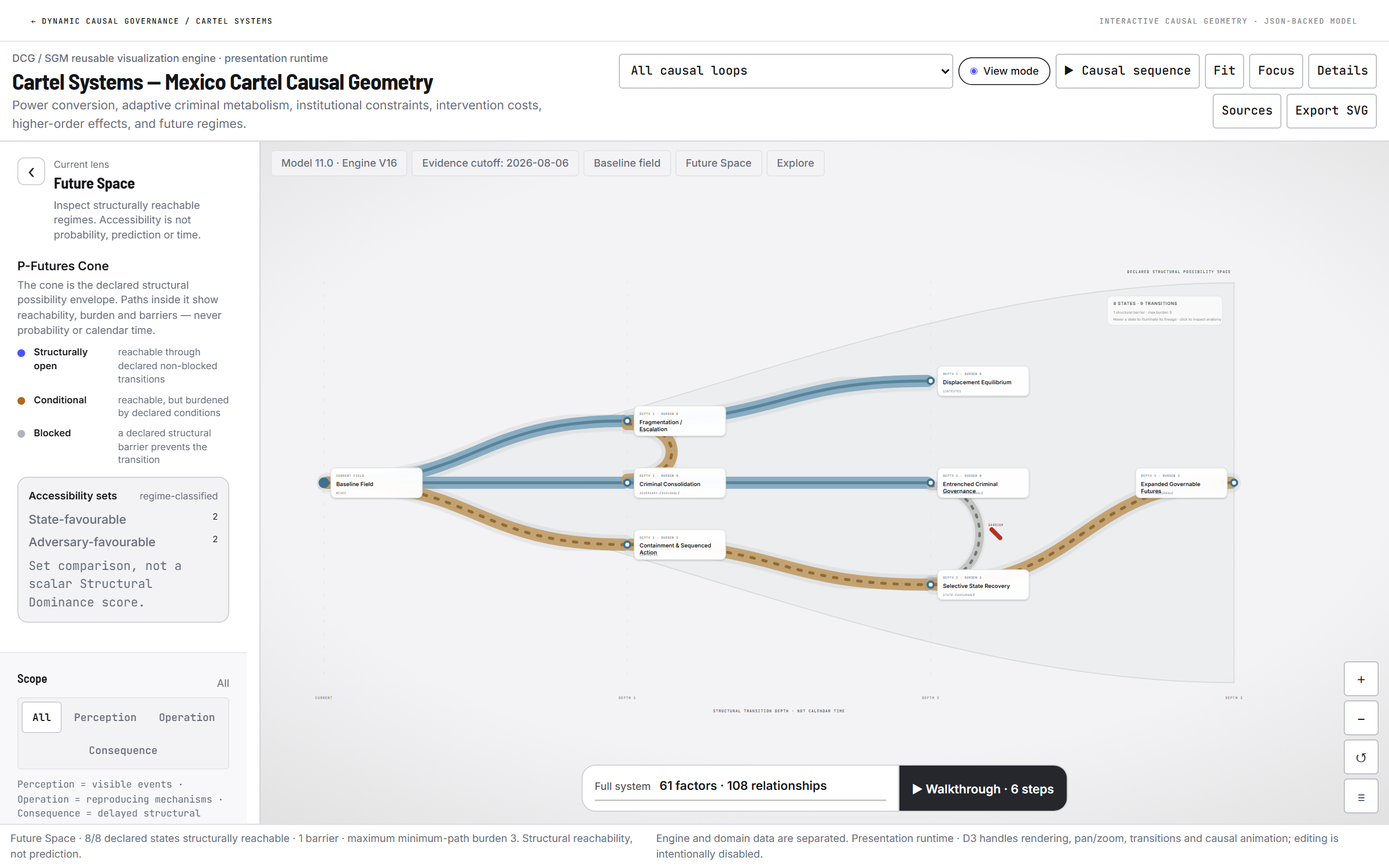
Five branches—not one predicted destination.
Each branch depends on the causal conditions that make it reachable, reinforced, fragile, avoidable or increasingly irreversible. None is assigned a point probability here.
- A
Fragmentation cascade
Succession failure, contested routes and increased replacement demand amplify violence and reduce observability.
- B
Consolidated criminal governance
Lower visible conflict can conceal stronger rule-setting, dependency and protected markets.
- C
Competitive equilibrium
Persistent rivalry stabilizes without restoring formal authority or reducing structural harm.
- D
Selective state recovery
Protected reporting, institutional continuity and reduced conversion improve local governability.
- E
Network displacement
Pressure reroutes actors, commodities, jurisdictions and transnational connections.
How Structural Dominance is assessed
A multi-dimensional profile examines regenerative capacity, conversion, observability, institutional penetration, local dependency, succession, territorial control, narrative, adaptation, cross-border coupling, state coordination and community resilience.
This is an analytical profile—not a universal score or a cartel ranking. Spectral composition is one layer of the diagnosis, not a substitute for the wider causal architecture.
Explore Power Architecture →Change the conditions of reproduction—not just the visible node.
Intervention classes belong in a sequenced portfolio. These are governance-level considerations, not operational targeting or tactical instructions.
- 01
Reduce replacement vulnerability
Change the conditions that make recruitment scalable rather than relying on attrition alone.
- 02
Increase conversion friction
Beneficial ownership, traceability and sector-specific safeguards can constrain metabolism.
- 03
Protect continuity and integrity
Vetting, case continuity and evidence security matter before adding capacity to penetrated systems.
- 04
Restore observability safely
Reporting without credible protection can expose communities and deepen silence.
- 05
Govern coupled resource fields
Arms, illicit finance, commodities and demand require coordinated, substitution-aware measures.
- 06
Treat leadership pressure as conditional
Succession, spillover, protection and post-intervention governance must be modeled first.
When restraint is an active decision
Broad pressure can intensify factional competition, increase civilian exposure, destroy observability or create room for a stronger successor. Direct non-intervention may be temporarily preferable alongside protection, containment, evidence accumulation and preparation for sequenced action.
Restraint is not passivity when it has conditions, monitoring signals and a review cycle.
Move from the argument to the causal geometry.
The separate Cartel Geometry application exposes the JSON-backed model. These are real interface captures—not decorative diagrams.
Spectral Composition / How power carries a relationship
The same relationships are read by power modality rather than causal polarity: Red, Yellow and Blue. Presence is qualitative and evidence-linked, not a universal magnitude.
Future Space / Reachability, burden and barriers
The runtime's eight states and nine transitions are model objects, distinct from the five editorial branches above. Depth is transition distance, not calendar time; paths show declared conditions, not probabilities.
The demonstrator connects an evidence universe, ontology, causal canvas, SGM, future-space, intervention comparison, decision contract and structural memory. AI and predictive outputs remain governed inputs—not autonomous authority.
For an abstract demonstration of the three analytical lenses, explore Interactive Structural Intelligence on the Home page.
Keep evidence separate from interpretation.
Observations, published reports, model-dependent estimates and conditional futures retain different statuses even when they appear in the same causal field.
INEGI ENVIPE 2025 reports that 93.2% of crimes were not investigated—the hidden figure relevant to observability and institutional response.
INEGI ↗The Mexico Peace Index 2026 reports a 5.1% national improvement in peacefulness in 2025 while Sinaloa deteriorated sharply.
MPI 2026 ↗Published recruitment estimates are treated as model-dependent and scientifically disputed; they are not used here as a settled headcount.
Review under analysisLoops, power conversion and future branches are DCG analytical objects to challenge against local evidence.
Not observationThe five futures express conditional accessibility. None is presented as a point forecast.
ConditionalScope: open-source research demonstrator; article evidence cutoff 5 August 2026. The interface captures carry their own model version and cutoff. No classified access, tactical targeting or universal ranking is implied.
Model limits: incomplete observability, contested recruitment estimates, uncertain local transferability and adaptive responses can change the interpretation. The loops and branches are analytical objects to challenge, not empirical laws.